



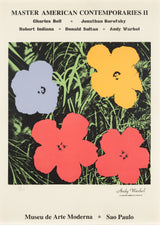
Andy Warhol (1928-1987) is arguably the most important American artist of the 20th century. He not only helped to define Pop Art, but has made a profound and enduring effect on artists and image-making around the globe.
From the outset of his career in the 1950s to his final works in 1987, printmaking played a key role in Warhol’s practice. The floral motif starts with Warhol’s iconic Flower paintings and prints from the mid-1960s. In these, he reduces hibiscus flowers to a basic form, rendering them in unnaturally vivid hues similar to the textile patterns and palettes of that era.
In focusing on a single subject and repeating it across mediums, Warhol referenced commercial and mechanical forms of reproduction commonly used in advertising and the media at large. Other than demonstrating his mastery of and passion for screenprinting, the Flowers images embody Warhol's core tenant, engaging with questions of appropriation and production that are central to an understanding of his work as a whole.
Warhol's Flowers hold a unique position in the canon of his prints. While there is no cultural context beyond the image itself, not illustrating a brand, figure, or celebrity, they are instantly recognizable as Warhol's. Bold and accessible, these flower images made a statement without taking a side during the emotionally charged era of the 1970s. They remain one of the most beloved images from Warhol's oeuvre.
Questions about this piece? Contact us, call +1.416.704.1720, or visit our Toronto gallery.
Andy Warhol, After (1928-1987)
"Poppy Flowers for the Museu de Arte de Moderna, Sao Paolo"
1994
Screenprint with added text on Stonehenge Rag
Numbered "17/50" in pencil, lower left
Stamped by the Estate of Andy Warhol, lower right
Edition: 50 + 10HC
Printed and Published by American Image Editions, New York
40"H 30"W (work)
41"H 31"W (framed)
Note: This work is an original Andy Warhol screenprint that was authorized by the Warhol Foundation to be the feature print in the Master American Contemporaries II Portfolio.
- Where does the inventory ship from?
Our inventory is divided between New York and Toronto.
- Where do you ship to?
We can ship anywhere. Typically when we ship within North America we prefer to use FedEx or DHL. To Europe, Asia and beyond we generally use DHL.
- How much does it cost to ship?
For shipments within North America, we typically charge a flat rate fee. Many items on our site will list the rate. For shipping outside of North America, we can easily provide a quote and will look for the most efficient and economical option.
Most of the items on our site can be easily shipped internationally.
Occasionally we will recommend that an artwork be removed from its frame for shipping. Larger framed works are typically framed with plexiglass. We export over 80% of what we sell, so we are comfortable shipping anywhere.
- Are there additional taxes or fees?
When a work is valued above $2,500 usd there is a possibility of tax of 0.35%, but this is applied sporadically. There can similarly be an additional fee for customs brokerage and this can range from $20 - $65. US Taxes, duties and customs brokerage are not included in our flat rate shipping. However most of our shipments to the US enter without any additional fees.
- Do you provide a certificate of authenticity?
Yes, we guarantee everything we sell. We can provide both a digital and printed version of our certificate of authenticity.
What is your return policy?
- Caviar20 wants you to be 100% satisfied with your purchase. We have a 7 day no-questions full refund return policy for your purchase. Shipping charges are non-refundable. Return shipping is the responsibility of the customer. After 8 days returns are given a credit note. There is no expiration for our credit notes.
- What payment methods do you accept?
Canadian clients are welcomed and encouraged to pay with interac.